

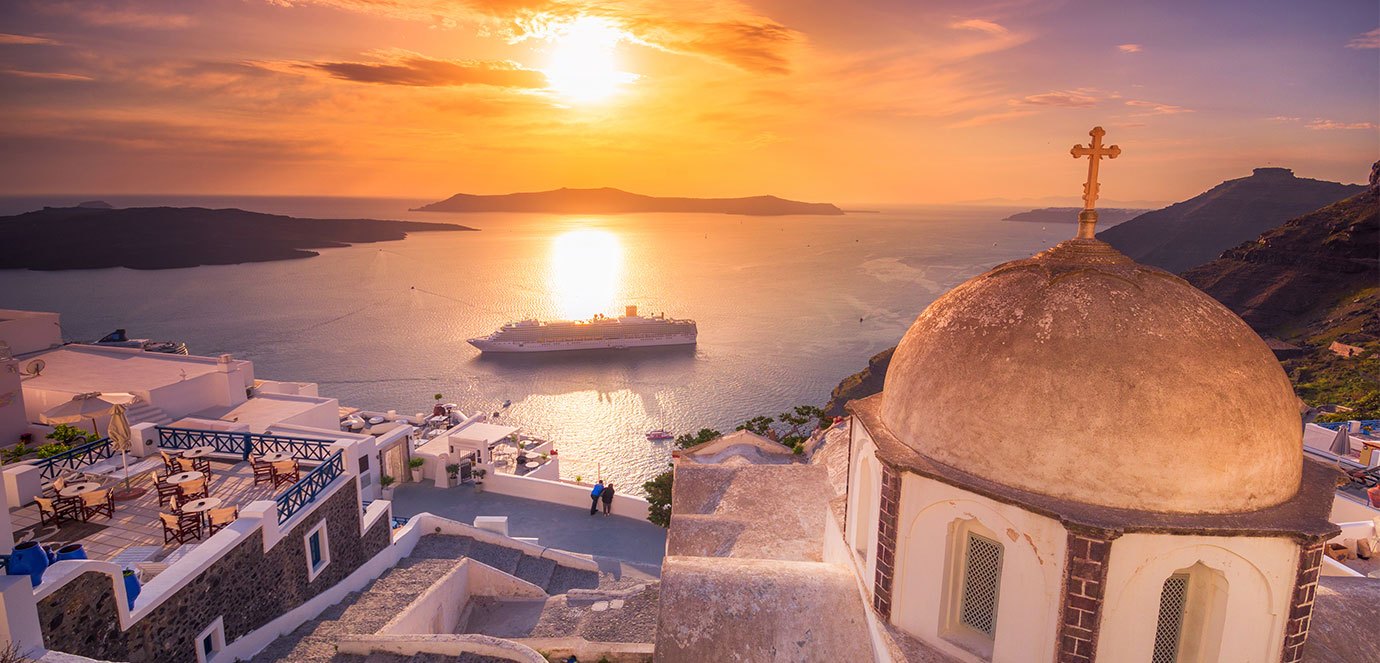
You’ve probably heard of this island, as Santorini is considered the most famous island in Greece. Much has been written about its volcano and many historians and researchers worldwide have studied it. If you have visited it, you will surely know what makes it so sought after. If not, it’s time to get to know it up close.
Did you know that Santorini?
- Its official name is Thera
- It was colonized by the Lacedaemonians, led by Thera, who gave his name to the island
- In 1613 BC, it experienced perhaps the largest volcanic eruption ever recorded on Earth
- It has a volcano that is still active today
- In ancient times, it was called Strongyli and later Kallisti or Kallisto
- (“Santorini”) The name comes from the Frankish Crusaders
- It attracts around 3 million visitors annually
- It is famous for its unique sunsets
- It is located approximately 142 miles from Athens, from the port of Rafina
- It takes 5-9 hours to get there by boat from Athens
Thira, the official name of the island
Although it is known worldwide as Santorini, Thira is the official name of the island. This means that “Thira” is used legally and administratively in official documents, maps, and government services.
Where did the word Thera come from?
According to history and archaeological findings, it appears that Thera was colonized by the Dorians/Spartans around the 9th century BC. The leader of the Spartans, Theras, gave his name to the island. Etymologically, the word Thera is related to the words θήραμα (thērama) and θηρευτής (thēreutēs), meaning hunting.
The great volcanic eruption of 1613 B
According to volcanologists, in the spring of 1613 BC, one of the largest volcanic eruptions, if not the largest, ever known to mankind occurred. The volcano was preceded by a major earthquake, and then Stroggili was blown up along with the volcano’s crater. Ash, cinders and huge amounts of volcanic material were scattered everywhere and over great distances, creating a suffocating atmosphere. Huge tidal waves reaching 20 meters high rose and reached the coasts of Crete. The prehistoric settlement of Thera was completely destroyed and all its inhabitants were lost, estimated to be over 10,000, as there was no time to escape.
In the more recent past, the last intense seismic activity occurred in 1950. Today, the volcano of Santorini remains active in a state of calm but is always under constant monitoring.
Historical overview of names
Another ancient name referring to Thera is Strongyli. Once, before the great volcanic eruption, Santorini was indeed a volcanic island, round in shape.
Its later name is Kallisti or Kallisto, which means the most beautiful of all. The superlative degree of the adjective kalos, which is related to the ancient Greek kallos that symbolized Supreme Beauty, both external and internal, developed and was expressed in all its forms, from lyric poetry and sculpture, to philosophy and the grooming of people. Therefore, the name Kallisti honors Santorini for its unparalleled beauty. Even today, there are companies whose brand names contain the word kallisti to emphasize the high quality of their services.
During the Ottoman occupation, the official name of the island was Thira. However, the Ottomans also called it De(i)rmezik, which means “small mill,” as the island was full of windmills. The inhabitants took advantage of the wind power available on the Greek islands and used windmills for grinding.
Why did the name Santorini prevail?
During the Frankish occupation, the island was under the control of the Franks. As there was a church on the island dedicated to Saint Irene, they began to use the name Santa Irini. Santa Irini was gradually renamed Santorini and eventually became the most prevalent, widely known, and touristic name of the island.
Popular tourist destination
Today, Santorini is one of the most popular tourist destinations in the world. Hordes of tourists from all over the world arrive daily to admire this awe-inspiring island with its imposing caldera and accommodations built literally on a cliff. The entire landscape bears witness to the intense volcanic identity of the island. The contrast between the wild beauty and the Cycladic character is evident everywhere in Santorini. Wander through narrow streets, whitewashed houses, and churches with blue domes, and beaches with black pebbles and red sand. Discover the enchanting beauty of Fira, Oia, and Imerovigli and capture the best sunsets you have ever seen in your life!
How long does it take to get to Santorini from Athens
To get to Santorini from Athens and the port of Rafina, it will take you just over 5 hours by speedboat. During the summer season, you will find daily routes from Athens to Thira and vice versa.